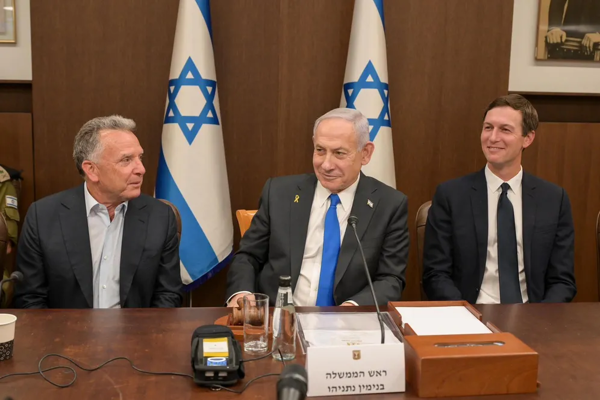
Jerusalem, November 16, 2025 – The Chief of the General Staff of the Israel Defense Forces (IDF), General Eyal Zamir, confirmed that the Israeli Army maintains operational control over more than half of the Gaza Strip and warned it is prepared to take new areas of the enclave if necessary for security reasons.
Zamir presented this deployment as an indispensable condition to avoid a repetition of the October 7th massacre, when Hamas commandos stormed southern Israel, killed about 1,200 people, and kidnapped hundreds of civilians and soldiers.
"We will not fear the consequences; everything is oriented towards the IDF advancing towards growth, learning, and progress," he affirmed, in a message directed both at the troops and at an Israeli public opinion still marked by the trauma of that day.
While the military command emphasizes the security logic and the need to prevent the "resurgence" of Hamas, Israel's control of more than half of the Strip and the consolidation of the Yellow Line are drawing growing criticism from abroad.
According to his details, the IDF "maintains operational control of over 50% of the Strip, without controlling the civilian population," but reserves the option for "a rapid transition to a large-scale operation to establish operational control of additional areas" if the Hamas threat justifies it.
This control is supported by a network of fortified positions, armored routes, and an internal buffer zone that goes far beyond the old perimeter fence.
"Although this will take time, we will persist in the mission to dismantle Hamas and demilitarize the Gaza Strip, either through an agreement or by military means," the military chief stated, while emphasizing that the units of the Southern Command continue to "cleanse" sectors, destroy tunnels, and attack residual foci of Islamist militias.
At the same time, Zamir referred to internal investigations into the failures that allowed the 2023 attack to happen.
He recalled that upon assuming his post as Chief of the General Staff, he created a committee of experts to comprehensively review the IDF's actions on October 7th and during the initial phases of the war, with the commitment to "seek the truth" and extract operational lessons.
In the western part of Gaza, Hamas is trying to rebuild its power structure and maintain an armed presence, while in the east, the IDF reinforces its positions and controls the main movement routes, supported by drones, artillery, and armored forces.
The message, launched during a visit to the Gaza Division and the Rafah area, consolidates the shift towards a prolonged Israeli presence in the territory, more than two years after the October 7th, 2023 attack and amidst an international debate on the redefinition of de facto borders in the Palestinian enclave.
Zamir reviewed the situation on the ground in the so-called "Yellow Line," the new security cord that Israel drew inside Gaza and which functions as a limit from which the return of the Palestinian population to vast devastated areas is prohibited.
Analysts and diplomats warn that this internal security strip—combined with the corridor that bisects the enclave—is crystallizing a de facto border, very similar to the ceasefire line agreed upon in October of this year but extended over Palestinian territory.
International organizations and experts in international humanitarian law warn that the massive destruction of neighborhoods, infrastructure, and agricultural fields, as well as the recurrent shooting of civilians attempting to return to their homes near the new line, could constitute serious violations of international law and consolidate a prolonged occupation.
On the ground, the reality remains that of a low-intensity war, despite the formal ceasefire negotiated in October.
Armed incidents around the Yellow Line are frequent, and civilian casualties are still recorded every week in a territory where the health, energy, and supply infrastructure is severely damaged after months of fighting, bombardments, and blockades.
Zamir's message from Rafah confirms that, far from preparing an orderly withdrawal, the Israeli military leadership is preparing for a prolonged scenario: operational control of large portions of Gaza, without formally assuming civilian administration of the enclave, but effectively conditioning its geography, borders, and possibilities for reconstruction.
The balance between the security demands posed by Israel and the human and political cost that this regime imposes on the Palestinian population will once again be at the center of diplomatic discussions in the coming weeks, in a conflict that, despite the changing phases, is far from finding a stable solution.
"We will continue to insist that the Hamas regime does not exist on the other side of the border."