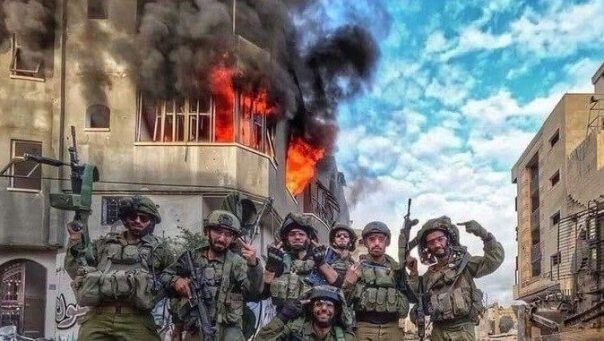
It is very difficult to predict exactly what will happen in the near future, but some quite probable scenarios can be envisioned. One is that Egyptians will continue to reject until the end the relocation of two million Palestinians to their territory, which would force the Israelis to try, and they are already talking about it, to build what they call the great city of refugees on the border between the Gaza Strip, Sinai, and Egypt. By the way, at the moment, the Israelis do not have the money to build it. Is it possible to replace Israel with a secular state, in which Palestinians have the same rights as Israelis, a country where each person has a vote? Unfortunately, I cannot promise anyone living in Gaza that this will immediately lead to the end of the genocide. On the one hand, from the international community, which now has to be loyal to something that most leading countries in the West, apart from the United States, of course, have said that if this is carried out, they will impose severe sanctions on Israel. And, secondly, I have no doubt that there will be two population movements here that will be the final act. One (and I think this also happened to some people in the white community of South Africa), Israelis who would not want to live in a non-apartheid state and who would have dual nationality or jobs that could start outside of Israel would leave, and they can leave. But if you listen, observe, and speak with the younger Palestinians, you can see that there is human capital that would be able, I believe, to restructure the Palestinian liberation movement, orient it towards a much more effective path in the future and take charge, not only in the struggle to dismantle Zionism, but, more importantly, in leading the debate on what should replace a decolonized Israel or, if I am not mistaken, a disintegrated Israel in which the Zionist project will collapse before our eyes. Chris Hedges: Before asking you what that collapse will look like, the roadmap to that collapse in terms of concrete steps, let's talk about Egypt. One is the final change, but that would be the last thing to happen, a change in Israeli Jewish society similar to the one that took place in the white community in South Africa, willing to admit that there is no other option but to renegotiate reality. I know that it sounds totally unrealistic now, but I am talking about a different future with different events than would have occurred until that moment, including all the pressures I was talking about. So far, it works due to the weakness of Arab governments, due to a lack of self-respect and dignity. I do not want anyone to think that tomorrow Palestinians or any other people will be able to defeat the Israeli army. One, it was necessary to have sovereignty over all of historical Israel, that is, over all of historical Palestine, Israel, the West Bank, and the Gaza Strip. The attack itself failed and the position of Hamas has not changed. They were brought, well, not them, but their grandparents, so to speak, were brought to Israel in the early 1950s because the Zionist movement or the new State of Israel failed to convince millions of Jews living in the United States, United Kingdom, and parts of Europe to emigrate to Israel. And, very much to their chagrin, the Zionist leaders decided to bring people they considered Arab Jews, that is, who were not only Jewish but also Arab. This in itself is a type of irrational strategic and future behavior that, in my opinion, will also contribute to the disintegration of Israel in a more distant future. Chris Hedges: Can we argue that that is what they are doing now? And, in the meantime, the space of the state extends beyond the borders of what used to be historical Palestine or under mandate. And what was seen was a kind of, as Avi Shlamlo describes very well in his memoirs, I think it's called Three Worlds, tension, of inherent racism. I mean, you mentioned it in your book, and it's fascinating that those groups, many of whom were Arab Jews, or as you said, came from Morocco or Ethiopia, wherever they were, were mistreated by the Ashkenazim. To this is added the isolation in the world, which the more extreme the behavior, may not be limited to boycott and divestment campaigns and pass into the realm of sanctions. We are already starting to see signs of this, that some governments are willing, at least, to talk about sanctions. They have already expanded the, let's call it Greater Israel, to the south of Lebanon. An expansion like this, a lunatic behavior, if you will, typical of populist governments, wherever they are, has a price. The United States would be the one that would have to finance most of it, because until 2023, the United States provided Israel with $3 billion annually in aid. Therefore, I think the Americans knew it. They decided not to stop it by any powerful or forceful means and hoped, and probably still believe at this moment, that they have somehow managed to bypass this incident, as they would call it, and maintain their good relationship with both Israel and Qatar. At some point, this kind of adventurous policy will not be so easy to reconcile for the Americans. To this is added the change in the younger generation of Jews, especially in the United States, who with a Judea State like this would probably distance themselves from Zionism and Israel and, who knows, many of them could even become activists in the Palestinian solidarity movement. And, finally, I think we must pay attention to the youngest generation of Palestinians. This reality is not going to change. And this would increase the military pressure on Israel from the outside. It attacked the negotiating team in the hope that this would lead to a situation where negotiations would be unfeasible. Secondly, that it is carried out on enemy territory, which has not always happened. It is dominated by extremist Jewish groups that have turned Israel into what he calls the State of Judea, distinct from the old State of Israel. At the same time, as the American empire crumbles, a process accelerated by the ineptitude and corruption of the Trump administration, the fundamental pillar of support for Israel will erode, forcing the United States to reduce its spending, even in the Middle East. What will the collapse of Israel mean for the Israelis, the Palestinians, and the Middle East? And that is also reflected in the quality of the equipment, in its ability to serve the political objectives of the Government. They depend on the United States to build that city. However, I think many Palestinians in the Gaza Strip would resist being moved to that ghetto. And it would not only be that the Egyptian army is now very close to the Israeli army, something that was avoided for many years thanks to the peace treaty. However, all this does not mean that there are not young Israelis who are still enthusiastic about enlisting not only in the army, but even in elite army units. But there is a fatigue that also reflects the lack of social cohesion between those who serve and those who do not serve. And the option, the most attractive option, is, of course, to leave Israel if one can, if one does not want one's children to serve in the army, and that happens in large numbers. Otherwise, it would not fit into what is, at least, 20 years from now. So the army still has the power to control the civilian population to destroy it, subject it to genocide, terrorize it, as they do in the West Bank and inside Israel. The question is, judging by our historical precedents, can this continue forever? The second fatigue is that of the equipment, as revealed by Haaretz recently, there is a problem with the equipment that Israel has because the Israeli strategy, reflected in the equipment it produces and buys, is designed to win wars under three conditions: First, that Israel initiates the war, and this did not happen in 2023. You have written: «Thus, a possible fall of Israel could be like the end of South Vietnam, the total disappearance of a state, or like South Africa, the fall of a specific ideological regime and its replacement by another. This neo-Zionist state has abandoned the gradual approach, the slow ethnic cleansing of Palestinians, which characterized previous Zionist governments. It is using genocide as a weapon to empty the Gaza Strip of Palestinians and, soon, perhaps also the West Bank. It would face conventional armies. The one that began in 2012 and one of the manifestations, I think, of any new political order in the Arab world will be that the regimes, the rulers, the governments, whatever they are, the political elites, will more faithfully reflect what their societies want their states to do with respect to Palestine. Then Israel would not face two small guerrilla armies that it can defeat with relative ease, although even that they have not been able to do. Totally agree. There is already a military presence in the south of Lebanon, in the south of Syria, and I do not think they will stop there. The Israeli Air Force would not have sent a single plane to that airspace without informing at least that headquarters. So I think the Americans knew that this was going to happen. There is not much to highlight about the current leadership of the Palestinians in terms of unity, vision, and effectiveness. But it will include an attempt to do it with horrible consequences. And a lot depends on the international community, not just the Arab world. And from time to time it is good to show all parts of the Middle East that they have the power and the ability to do whatever they want, regardless of international law or the sovereignty of Arab countries. They really have the feeling that the Arab world, or at least the regimes of the Arab world, are completely at their mercy and under their domination. This could tame Israel. But once the Likud, under the leadership of Menachem Begin in 1977, ended the rule or predominance of Labor Zionism in Israeli and Zionist politics, these ideologists became much more influential and began to develop through centers of learning, through the writings of their rabbis, their gurus, a kind of literature of a very ideological nature that interpreted the reality of the seventies and eighties and, later, of the 21st century as a monumental historical moment in the life of the Jewish people, in which the ancient Israel would return and the glorious days of the past would be lived again. And for this, according to the ideologist, two things had to happen. Because when one speaks of a confrontation, the only military power in the Middle East that has the capacity to do it, well, perhaps Saudi Arabia, but that really has the ability to cause any kind of harm to Israel is Egypt. Ilan Pappé: Well, I am sure that the president and the Egyptian government are not very enthusiastic about the idea of the Egyptian army entering into a military confrontation with Israel. This is something that, regardless of what we think about the former president of Egypt Gamal Abdel Nasser, the previous leaders of the Baath in Syria and Iraq would not have tolerated such behavior from Israel. Do you think that is really possible? How do we get there? And at first, this was… Chris Hedges: Let me interrupt to clarify to the listeners that it was then that Israel occupied Gaza and the West Bank, including East Jerusalem. Ilan Pappé: And the West Bank, of course. So I am glad you mentioned it. Israel is a small country, it has a population of seven million or something like that. This, he argues, means that ultimately Israel will fracture, making it unsustainable. I think that, in the case of Israel, elements of both scenarios will develop before many of us can understand or be prepared for it». There are internal divisions. And then, of course, there are all those estimates of how many Israelis have left the country since October 2023, which even reach up to half a million. But it seems there is a kind of fatigue. And the beginning of the movement of Palestinians returning from refugee and exile communities, changing the demographics, changing the political options, and although this may surprise some people, my 70 years of experience with Palestinians makes me fully convinced that the basic thrust of the Palestinians, if we are reaching a moment in which they are beginning to free themselves from more than a century of oppression, colonialism, and ethnic cleansing, my feeling is that the basic thrust is not revenge, nor punishment, but rather restitution, the desire to rebuild the normal life they had before the arrival of Zionism. And I think that, in reality, the inspiring model will not come from European political models, but from the past before 1948, when Muslims, Christians, and Jews genuinely coexisted, not only in historical Palestine, but also in the Eastern Mediterranean and North Africa. Chris Hedges: I just want to finish by asking about the so-called Israel Defense Forces (IDF) and the pressures they are under. And within the West Bank, which a group of Israeli ideologists and right-wing political groups considered the ancient land of Israel, a certain ideological infrastructure developed. At first, it was very marginal. Basically, they are expanding Greater Israel towards Gaza. That is one thing. Otherwise, as you have rightly said, they become wars of attrition. These three elements have not been met. It is the DNA of the current Israeli government, the feeling that they are the rulers of the Middle East, that they are the dominant power. Is that what is driving this expansion? The religious groups took over the government and exerted great influence on the younger generation. It had very little impact on Israeli politics. That is, they influence other processes almost like on a billiard table. For example, the more aggressive the Israeli territorial expansion, the more cruel the punitive and adventurous action of Israel, that is, its intrusion into the entire Arab world, the more the Arab world itself will be subjected to an internal process of change that has not yet taken place. The so-called Arab Spring did not produce dramatic changes in the regimes of the Arab world, but a situation like this, with an escalation of territorial expansion and punitive actions of Israel, can lead to a continuous revolution. And the entire region is governed from there with vassals, allies, and enemies who are constantly punished. I am not an expert in American politics either, I bow to your knowledge, but I refuse to adopt teleological deterministic views on the future. History is cyclical and not linear, so I believe, and not only hope, that there is a possibility that a different type of politics will emerge in the United States, not tomorrow or the day after tomorrow, mainly because populist leaders like Trump are also not very competent in managing economies and societies or in international relations, and therefore I believe that any concrete change, any positive change, in American politics, not in a very near future, as I say, but in a more distant future, would play a very important role in closing the options for the Israeli regime to continue maintaining a system of apartheid, expansion, ethnic cleansing, and, hopefully, no more genocides. And this is also something that I think we must pay attention to, that even if Israel has militarily defeated Hezbollah and probably has defeated or at least limited the options of Iran and Hamas, it still controls millions of Palestinians in the West Bank, in the Gaza Strip, inside Israel against their will, facing the millions of Palestinians living in refugee camps on the borders of Israel with their own connections to the local militias and the resistance movement, this is not going to disappear. It seeks to establish an Israeli empire that dominates its Arab neighbors, especially Lebanon, Jordan, and Syria. The hatred towards Palestinians by those who lead this neo-Zionist state, the State of Judea, extends to secular Israeli Jews. And then, this whole American game of navigating or balancing the two different interests of the United States in the region, this act of balancing, may no longer be possible in the future. Chris Hedges: A few months ago, at a dinner in Cairo with the former head of Nasser's Ministry of Information, whom the former president of Egypt Anwar El-Sadat had imprisoned for ten years, he raised exactly the same argument. That is why I include the setbacks and the violence, unfortunately, with the profound hope that it will be isolated cases and not the norm, more than the exception in the process. So it was not only Mizrahim against Ashkenazim, but also an entire generation of young Israelis who went through what could be called a national-religious, rather than democratic-secular, identity through a national-religious educational system that produces graduates who are racist, theocratic, in their view of democracy, human rights, and civil rights, and very committed to the Zionist dream. Some of those young people we have seen in the selfies they themselves filmed during the Gaza genocide and it is very easy to recognize the language they use, the hatred, the racism, and, unfortunately, this is not a marginal phenomenon. It is also the pressure from within Egyptian society for what Egypt would be so clearly involved in something that is happening a few meters from the border between Egypt and Israel. But it is possible that one day they will realize that this is too much for them. Since 2023, they have already paid into the Israeli bank account, so to speak, between 15 and 16 billion dollars, and the demand on American taxpayers to finance these ambitions would increase, and I am not sure that can be carried out, even if a Republican administration agreed. So they also face a serious economic crisis, although, of course, people continue to buy from Israelis military security products and securitization services. And, thirdly, and most importantly, that the wars be very short. But their peak came in November 2022, when Netanyahu, with all his problems, decided to align with that State of Judea coalition and was willing to give them whatever they wanted to stay in power. And that meant giving them the Ministry of the Interior, which in the United States would be the Department of Homeland Security, a powerful position within the Ministry of Defense and the Ministry of Finance, but even more important, I believe, was to allow them to occupy high-ranking and important positions in the police, the army, and the secret service. So now they have a very strong control over the State of Israel as a whole, and by that I mean that the state they refer to, which I call the State of Judea, is gradually absorbing, the State of Israel. Chris Hedges: These are the Mizrahim, as they are called in Israel, and there has always been tension with the Ashkenazim, the Jews born in Europe who dominated Israel, let's say, until the 80s. Let's start with the latest news from Qatar, the attempted assassination of the leaders of Hamas, who apparently had met to discuss and, according to all reports, accept the latest ceasefire agreement. Ilan Pappé: Yes, Chris, thank you for inviting me again to your program. Do we really know where Judea and Samaria were exactly? Yes, what we call the Six-Day War, and Israel occupied the West Bank and the Gaza Strip, along with the Golan Heights and the Sinai Peninsula. He said that the problem is not that Israel is strong, but that the Arab governments are weak. Ilan Pappé: Of course, of course. The Romans razed the Jewish temple. And there is an expansion of Greater Israel. And now we have the Al-Aqsa Mosque. There are all kinds of reports indicating that a significant number of reservists are not reporting for this new campaign in Gaza, that the casualty rates are much higher than we know. The second aspect is economic. Several Israeli soldiers celebrate the destruction of a house in Gaza. We share an interview with historian Ilan Pappé conducted by Chris Hedges and whose Spanish translation was originally published in Voces del Mundo and also on the Rebelión portal. Introduction The Israeli historian Ilan Pappé holds that Israel is imploding. But I do not think this is something that will hold in the near future, nor in a more distant future. Chris Hedges: Thank you. For example, I think there will be a change in the Palestine Liberation Organization. That is why, on the one hand, I tried to be realistic. So I hope that all this pressure will end up creating two types of internal dynamics, which will be the final act, so to speak, of this scenario, and a necessary act. Trump lies like he breathes, but of course he claims that he did not find out until the US army told him. The warning that was supposedly delivered to Qatar, according to the Qataris, began ten minutes after the bombing started. And I think these were the two objectives of this attack: one was tactical, related to the negotiations, but the other was part of that feeling of arrogance that now they are really the power in the area, which fits very well with that messianic neo-Zionist vision of rebuilding the ancient kingdom of Israel that they have read in the Old Testament, in the Bible, thinking that now they are able to rebuild it with the same kind of power and influence as before. Chris Hedges: And as for the reaction of the Trump administration, it is hard to know what is true. How do those forces contribute to the disintegration of the State of Judea, the State of Israel? Ilan Pappé: All these actions and strategies, when applied on the ground, have a dialectical connection with other processes. It did not seem difficult for me to imagine how I would like the historical Palestine to be in 2048. The big question that we all ask, especially those of us who support the solution of a single democratic state, is how do we get there? However, that would not be enough to maintain a decent economy. We will wait to see if they are willing to impose them. There is no doubt about it, with all the risk of saying what would have happened if in history this could be stated with certainty. Chris Hedges: Let's then talk about the State of Judea, what it means and how it differs from the State of Israel? Ilan Pappé: Yes, the State of Judea is the kind of political structure that began to emerge in the Jewish settlements, in the colonies in the West Bank after the June 1967 war. It does not seem to be much controversy internally about the genocide, but yes about this clash between the religious Zionists, the State of Judea, and the old State of Israel, if one can define it as a type of clash. So there are internal divisions. The massacre will continue. So let's talk about the pressure, of the internal military pressures that can contribute to this. Ilan Pappé: Yes, Chris, I am glad you mentioned it, because it is a factor that I write about in the book, but I forgot to include it as an additional indicator of a possible disintegration. We have had Ilan Pappé speaking about his book, Israel on the Brink. One is the human exhaustion. Otherwise, it would not happen. We have seen it with the protests against Netanyahu. This creates a very problematic mental infrastructure, as well as difficult social and economic conditions in which they found themselves, since they were pushed to the geographical and social margins of society. However, something else happened because the governments did not deal with the social and economic problems. It is not that there is a clear map in the Bible, there are no maps, but they have in mind a certain cartography that extends much beyond the historical Palestine, that is, Israel and the occupied territories, to Jordan, Syria, and Lebanon. Right now, that seems like madness and not a very practical, even possible or probable scenario. But what I was trying to do was, first, to avoid an idyllic picture of decolonization. But I do believe that this is the last stage of this particular massacre, which will not end with the total elimination of the Palestinians. The IDF were not created, never created to fight a war of attrition. It is evident that the Palestinians of Gaza, two million, are being pushed towards the border with Rafah, a 14-kilometer border that they share with Egypt. Egypt has moved military equipment along the border because it fears that the security barrier will be breached. Will it be the beginning of a decolonization process? I think it is where, supposedly, the Prophet Muhammad ascended to heaven. How would it look in practice? Ilan Pappé: Yes, as you know, in this book we are talking about, Israel on the Brink, this was the most difficult part, of course. Then, of course, there are the attacks that are being carried out in Iran and in Qatar. Ilan Pappé: Of course, that is the model they are building. The model is the center of gravity model. This time, due to the US involvement, it was clear that Hamas was making a great effort to satisfy Israeli demands, and therefore it was possible to reach an agreement, and the only way to prevent it was through that provocative attack against the Hamas negotiating team. It was not even about the leadership of Hamas. The genocide could even intensify, as if it were not serious enough enough. It had to be an old man. It is a tragic story and you are right, my friend Avi describes it very well in his book Three Worlds. It is a very widespread phenomenon and part of the power base of what I call the State of Judea. Chris Hedges: Like the Christian right in the United States, they see politics through the prism of the Bible and talk about what that means, especially this campaign to raze the Al-Aqsa Mosque, I think the Israeli Minister of National Security Itamar Ben-Gvir is one of the leaders in this objective, and rebuild the Second Temple. Of course, it is all mythology. And now I am 70 years old, so I would be an old man. It is possible, as you rightly say, Chris, that they find themselves in a situation where they have very few options. There is a limit to that kind of dishonest behavior. It is one of… Chris Hedges: Let me interrupt. [Laughter] Ilan Pappé: An old man. I want to thank Diego [Ramos], Sofia [Menemenlis], Thomas [Hedges], and Max [Jones], who have produced the program. (Transcription of the interview in English by Diego Ramos) Chris Hedges is a writer and journalist who won the Pulitzer Prize in 2002. I think that is one of the dimensions of that attack. The other dimension is the one you referred to in your introductory comments.