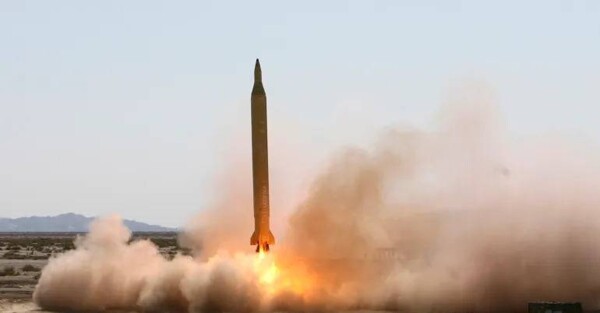
Israel raised the international alert level this Saturday by denouncing that Iran launched, for the first time since the beginning of the current war, a long-range missile capable of covering about 4,000 kilometers, a distance that, according to the head of the Israeli General Staff, Eyal Zamir, puts capitals like Berlin, Paris, and Rome under direct threat. This does not mean that Tehran already has a fully tested and deployed intercontinental missile, but it could be using or adapting space launch vehicle technology to project fire to distances previously considered beyond its immediate operational reach. According to coinciding versions that began to circulate from Washington, London, and Jerusalem, Iran fired two long-range ballistic missiles; one reportedly failed in flight and the other was reportedly intercepted by Western defenses before impact. Western military analysts have long suggested that Iran could have leveraged developments in its space program to extend the range of its missiles, even at the cost of losing terminal accuracy. This hypothesis gains strength after the attempt on Diego Garcia. That base is one of the most valuable nodes of the Anglo-American military deployment in the Indian Ocean, capable of supporting operations towards the Middle East, East Africa, and South Asia. While the attack did not cause damage to the base, the unsettling data is something else: the distance of the chosen target itself and the possibility that the regime has tested or deployed an intermediate-range vector superior to what it had admitted until now. The importance of Diego Garcia helps to understand why the episode was read as a signal of maximum severity. This ambiguity is part of Iran's own method: to deny, to insinuate, to exhibit, and to let the political effect of fear work on its own. And that single possibility, even before any definitive confirmation, is already enough to alter military priorities, missile defenses, and political calculations in much of the world. Sources consulted: statements from the head of the Israeli General Staff Eyal Zamir; reports on the Israeli complaint of a 4,000-kilometer missile and its potential reach over European capitals; Reuters coverage of the Iranian attempt to hit Diego Garcia and the Israeli assertion about the first use of long-range missiles in this war; Associated Press reports on the distance between Iran and Diego Garcia, the previous self-imposed 2,000-kilometer limit, and the hypothesis of use or adaptation of technology from Iran's space program.

Israel Reports Iran Missile Launch Threatening Europe
Israel raised the international alert level by denouncing Iran's first use of a long-range missile since the war began, one capable of reaching European capitals. This incident, linked to an attempted attack on an Indian Ocean base, raises serious concerns about the expansion of Tehran's missile capabilities and their impact on Western security.