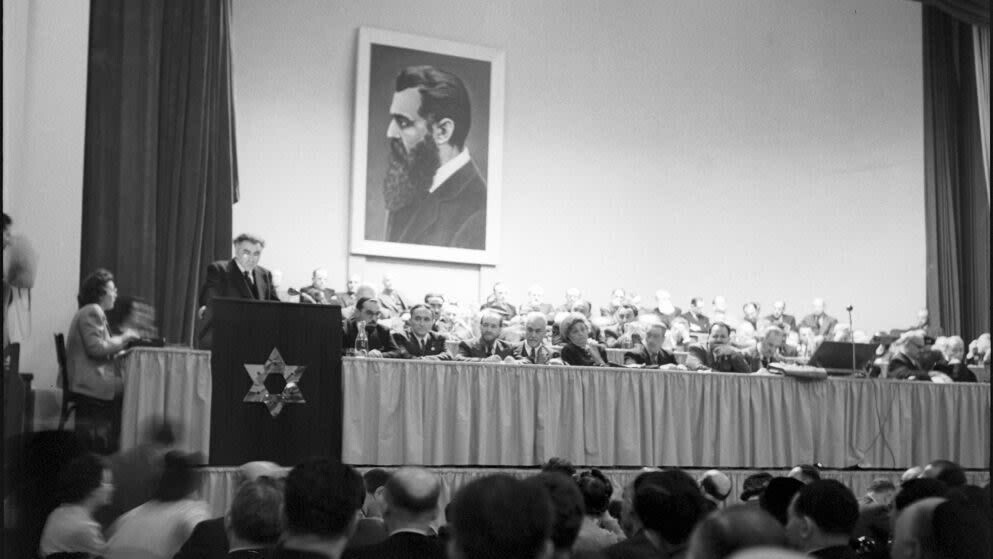
Zionism, in turn, is a modern doctrine and political-nationalist movement. There was a political Zionism, aimed at the creation of a state; a cultural Zionism, focused on reviving Jewish identity and the Hebrew language; a socialist or labor Zionism, which thought of national construction alongside forms of collective production; and a religious Zionism, which interpreted the return to the ancestral land also in a spiritual key. For others, however, it remained an evolving idea, traversed by debates about borders, security, identity, democracy, religion, and coexistence with Palestinians. It is also worth clarifying a common confusion: Zionism and Judaism are not the same. For its defenders, Zionism expresses the right of the Jewish people to national self-determination in their historical homeland. This distinction is central to not falling into caricatures. The historical weight of Zionism is also linked to a deeper experience: the memory of centuries of expulsions, pogroms, and persecutions, culminating in the 20th century with the Holocaust, which reinforced for vast sectors of Jews the conviction that without their own sovereignty, vulnerability could become extreme. Since then, for many, Zionism came to mean above all support for the right of Israel to exist as a national state of the Jewish people. But, beyond the contemporary dispute, there is one fact that remains: Zionism was and continues to be one of the most influential political currents in the modern history of the Jewish people and in the configuration of the contemporary Middle East. This diversity explains why, even within the Jewish world itself, Zionism was never a uniform current nor free from internal discussions. The main historical objective of the movement was concretized in 1948 with the creation of the State of Israel, after the end of the British Mandate in Palestine and the approval in 1947 of the partition plan voted on by the UN. In basic terms, it is a national and political movement that emerged at the end of the 19th century that held that the Jewish people, scattered for centuries and subjected in many places to persecution, discrimination, and violence, had the right to rebuild a sovereign life in their historical land, the Land of Israel. This dimension does not exhaust the discussion, but it helps to understand why Zionism was not just an ideological slogan, but also a historical response to insecurity, uprootedness, and lack of political protection. Today, more than a century after its modern formulation, the term continues to be an object of debate, support, rejection, and manipulation. The word itself refers to Zion, one of the historical and symbolic names of Jerusalem, and over time it came to identify a modern current that sought to turn that religious, cultural, and historical link into a concrete political project. Modern Zionism took shape in a Europe traversed by nationalisms, anti-Semitism, and the crisis of integration of Jewish communities. That is why there were and are Zionist Jews, non-Zionist Jews, and also anti-Zionist Jews. A year later, in 1897, he promoted the First Zionist Congress in Basel, an event considered foundational for the international organization of the movement. However, reducing Zionism to a single idea would be oversimplifying it. Likewise, criticizing a specific policy of the Israeli government does not automatically equate to rejecting Zionism as an idea, just as invoking Zionism does not by itself resolve all discussions about the conflict in the Middle East. For its critics, it raises questions about its political and territorial consequences, especially in relation to Palestinians. Its most emblematic figure was Theodor Herzl, an Austro-Hungarian journalist who gave a decisive boost to the political version of the movement. Judaism is a religion, a civilization, and a much broader and older historical identity. Speaking of Zionism requires moving beyond slogans and returning to history. In 1896 he published 'The Jewish State,' where he argued that the so-called 'Jewish question' could not be resolved only with assimilation or partial tolerance, but with a political solution: the creation of its own national home. Understanding what it is, before taking a position on it, remains a basic condition for serious discussion. Source: Part of this article, as a tribute, is based on the work of the same title by Luis Enrique Portalet, former Secretary of the editorial board of the defunct weekly 'Correo de la Tarde,' whose director was Francisco Manrique. From its origins, different currents coexisted within it. By Daniel Romero Jerusalem - March 16, 2026 - Total News Agency - TNA -